


[06/02/2026]
The Latin American Center for Physics (CLAF) and the French National Center for Scientific Research (CNRS) signed a cooperation agreement to establish a Latin American research network in astroparticle physics.
At an event held at the Brazilian Center for Physics Research (CBPF), in Rio de Janeiro (RJ), on January 27, the document was signed by Brazilian physicist Ulisses Barres de Almeida, director of CLAF and researcher at CBPF, and by French mathematician and computer scientist Antoine Petit, president of CNRS.
The main idea of the agreement -- launched at CLAF’s initiative -- is to strengthen international collaboration among the various experiments located in Latin America and institutions linked to CNRS in the field of astroparticles -- a general term referring to particles or radiation that reach Earth from space, basically encompassing cosmic rays, gamma rays, and neutrinos, whose study also enables understanding the formation and structure of the universe (cosmology).
For Barres, cooperation between CLAF and CNRS will enable the creation of “a continental network and a transatlantic collaboration”, based not only on the dissemination of knowledge but also on friendship among peoples. “The focus is integration through scientific diplomacy”, said.
For Petit, the initiative will help strengthen relations between France and the continent, because “CLAF goes well beyond Brazil”, a country with which CNRS has a long history of scientific and cultural collaboration. “I am very happy with the signing of this agreement’, said.
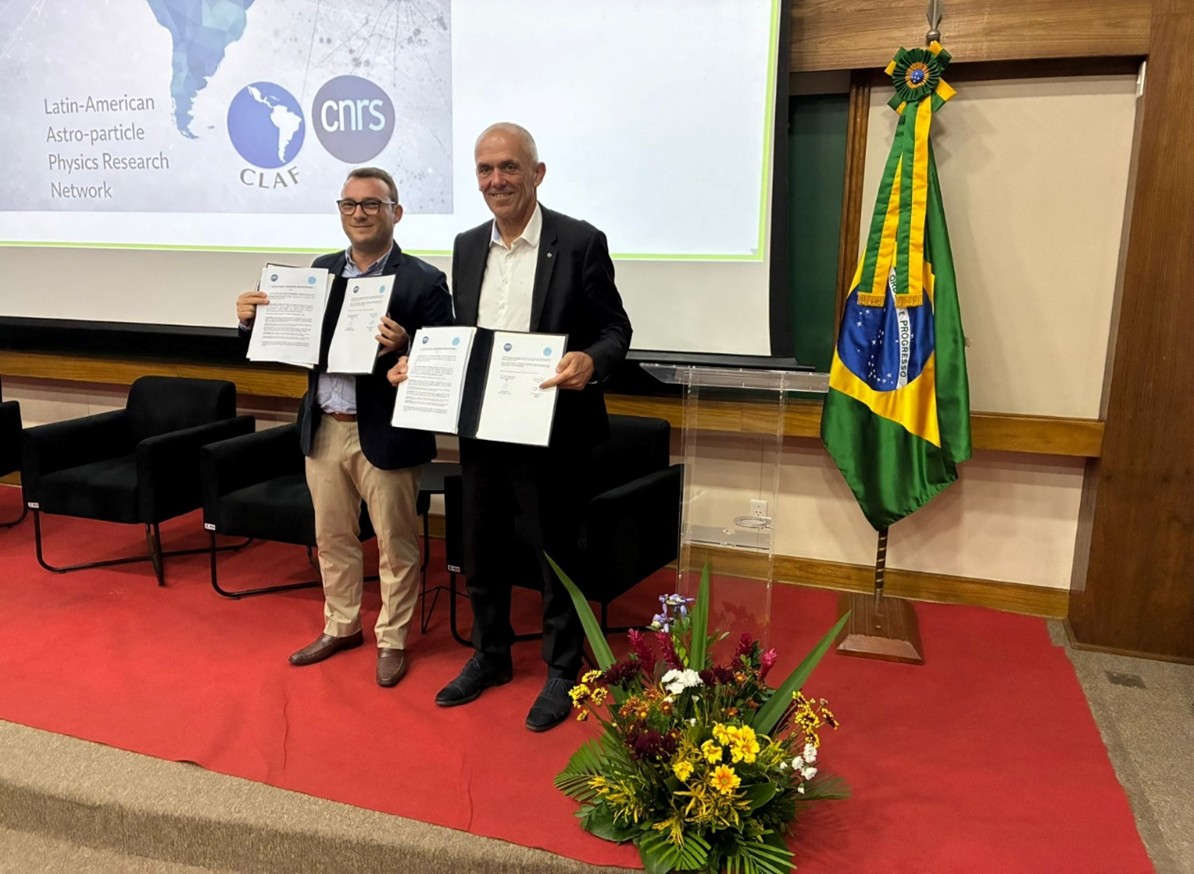
The event
Extending through the afternoon of January 27, the event opened with remarks by technologist Márcio Portes de Albuquerque, director of CBPF, who, after outlining the current situation of his institution, emphasized how international collaborations help “strengthen the ties between science, innovation, and society”.
Next, Barres, Petit, and French physicist Christelle Roy spoke. Roy is director of the National Institute of Nuclear Physics and Particle Physics, known by the acronym IN2P3, which is affiliated with CNRS. “This agreement is also a great opportunity for France”, said.
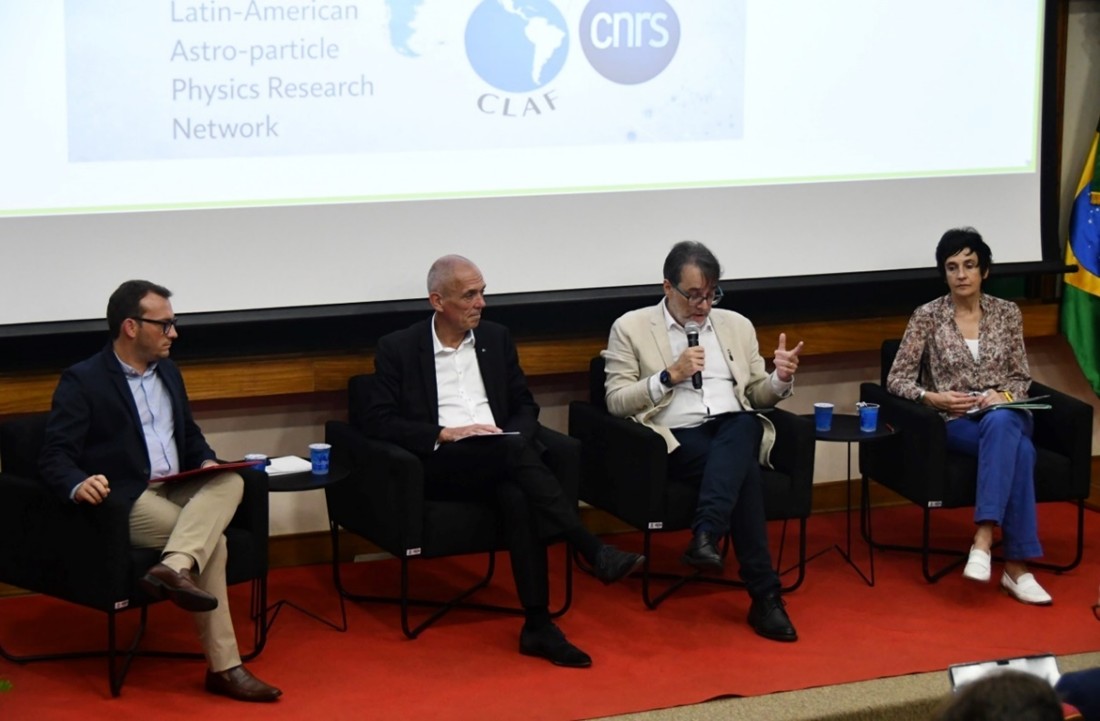
The French delegation also included engineer Liviu Nicu, director of the CNRS Office for South America. According to Barres, Nicu, who led the proceedings of the meeting, “was instrumental” in drafting the CLAF–CNRS agreement.
Invited by the organizers, engineer Olivier Fudym was also present. He is a former scientific and university cooperation attaché at the French Embassy in India and former director of the CNRS Office in Rio de Janeiro (RJ).
Lectures and testimonials
The meeting featured lectures by two participants. Barres gave a brief historical overview of CLAF before noting that, in Latin America, there is “a collection of international experiments”, but that the region has not yet reached what could be called “a Latin American physics”.
“We have islands of research, and a model for integrating them can come from Europe” -- a reference to the European Union. According to Barres, the collaboration signed with CNRS will help, for example, to connect experiments in Latin America that work in isolation but basically use the same technique for detecting astroparticles.
In the final part of his presentation, the director of CLAF proposed the creation of a regional and permanent forum for discussing topics related to the promotion of physics in Latin America, in collaboration with the United Nations Educational, Scientific and Cultural Organization (Unesco), to which CLAF has been linked since its creation, in 1962. “Such a body would be welcome on a continent where funding for science fluctuates considerably’, said.
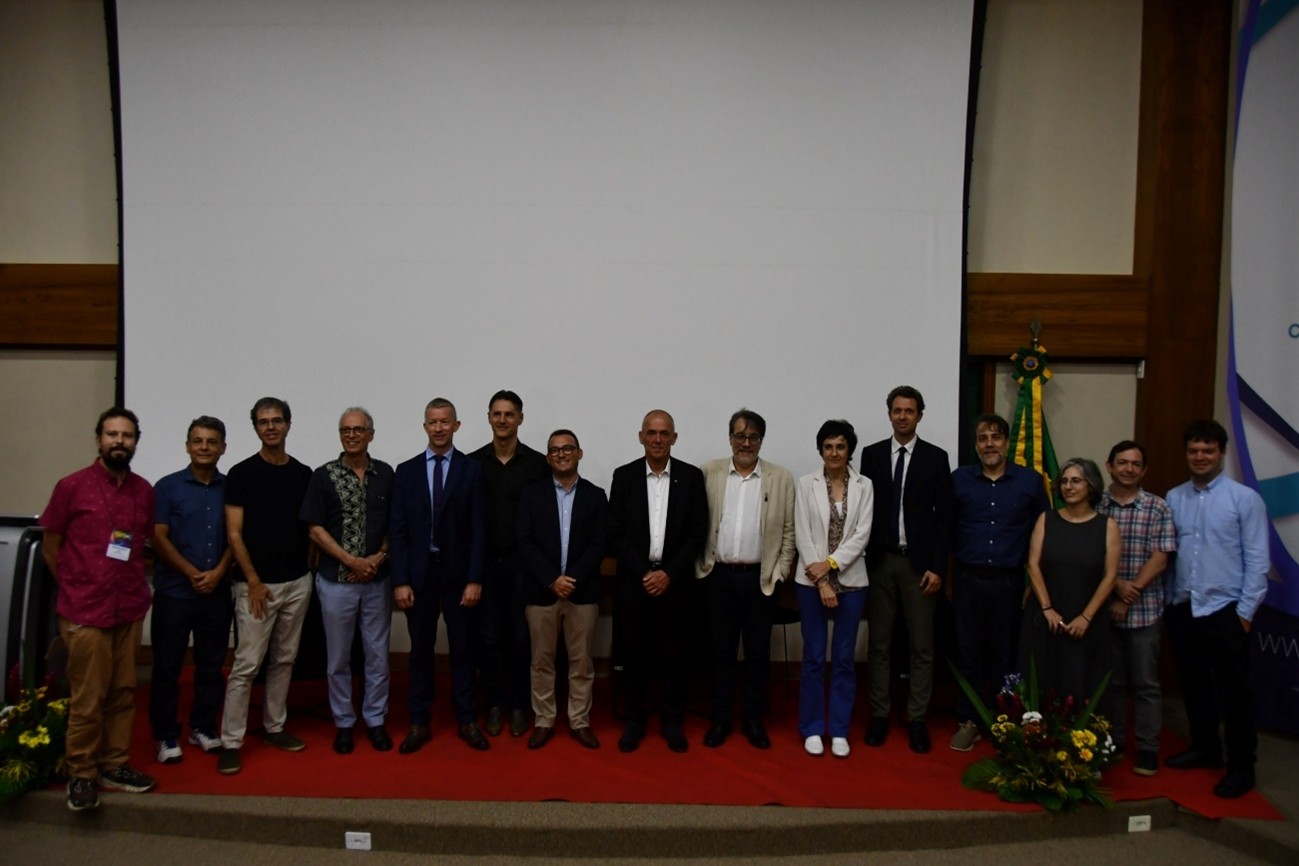
In her lecture, Roy presented an overview of CNRS, which currently has around 30,000 scientists and more than 1,000 laboratories in France. She then spoke about IN2P3 and highlighted strategies for collaboration with laboratories around the world -- six of them in Latin America.
Under the moderation of Alain Mermet, CNRS director for Europe and international affairs, the meeting concluded with testimonials from researchers who received CNRS support for their training or research. Among others, Albuquerque, who earned his PhD in France, spoke, as did physicists Martín Makler and Carla Bonifazi, both researchers at CBPF.
For Mermet, the scientific collaboration promoted by CNRS is “an instrument for peace”, based on three pillars: “trust, dialogue, and the free circulation of ideas”.
Before the meeting, the French delegation visited CBPF facilities and laboratories.