


[19/11/2025]
On November 14, the Latin American Center for Physics (CLAF) held a meeting to discuss opportunities for cooperation in the field of high-energy physics between countries in the region and the European Organization for Nuclear Research (CERN).
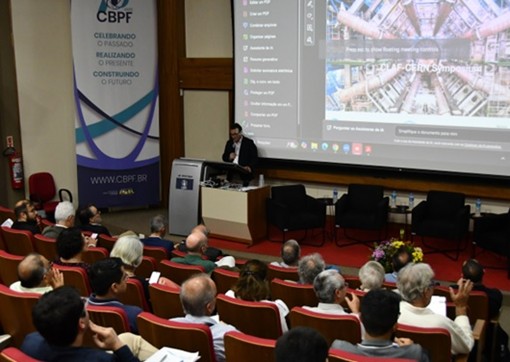
The symposium — held at the Brazilian Center for Physics Research (CBPF) in Rio de Janeiro (RJ), where CLAF has been headquartered since its founding, in 1962 — brought together about 25 researchers from Latin America and Europe for a full day of lectures, panels, and discussions.
The opening presentation of the event, ‘CLAF Symposium – Opportunities for Latin-American Cooperation in High-Energy Physics with CERN,’ was given by technologist Márcio Pontes de Albuquerque, director of the CBPF, who emphasized more than 40 years of interaction between Brazil and the European laboratory.
Next, Ulisses Barres de Almeida, CBPF researcher and director of CLAF, delivered the opening remarks, highlighting the importance of the event for the high-energy physics community in the region. “I hope this event marks the first step in a long series of activities between CLAF, CERN, and our communities, for the benefit of high-energy physics development throughout the Latin American continent,” he said.
In the morning session, the opening lecture presented an overview of the history of high-energy physics in Latin America. The event continued with talks by Salvatore Mele, senior advisor for international relations at CERN, and by Mário Pimenta (Portugal), who discussed the lessons that physics in his country has learned as one of CERN’s 25 Member States.
Two panels followed, covering the participation of Brazil and Chile in CERN. In one of them, Ignacio Bediaga (Brazil) discussed the work of the National High-Energy Physics Network (Renafae), which provides support for Brazil’s collaboration with the European laboratory.
Carlos Matsumoto, head of the special advisory office for international affairs at Brazil’s Ministry of Science, Technology and Innovation, spoke about the Brazil–CERN agreement on behalf of physicist Ricardo Galvão, current federal deputy and former president (2023–2025) of the National Council for Scientific and Technological Development (CNPq).
In total, Latin America has nine countries with users at CERN: Argentina, Brazil, Chile, Colombia, Costa Rica, Cuba, Ecuador, Mexico, and Peru. However, so far, Brazil is the only country in the region with ‘Associate Member State’ status, an agreement finalized last year between the government and the European laboratory.
Memorandum
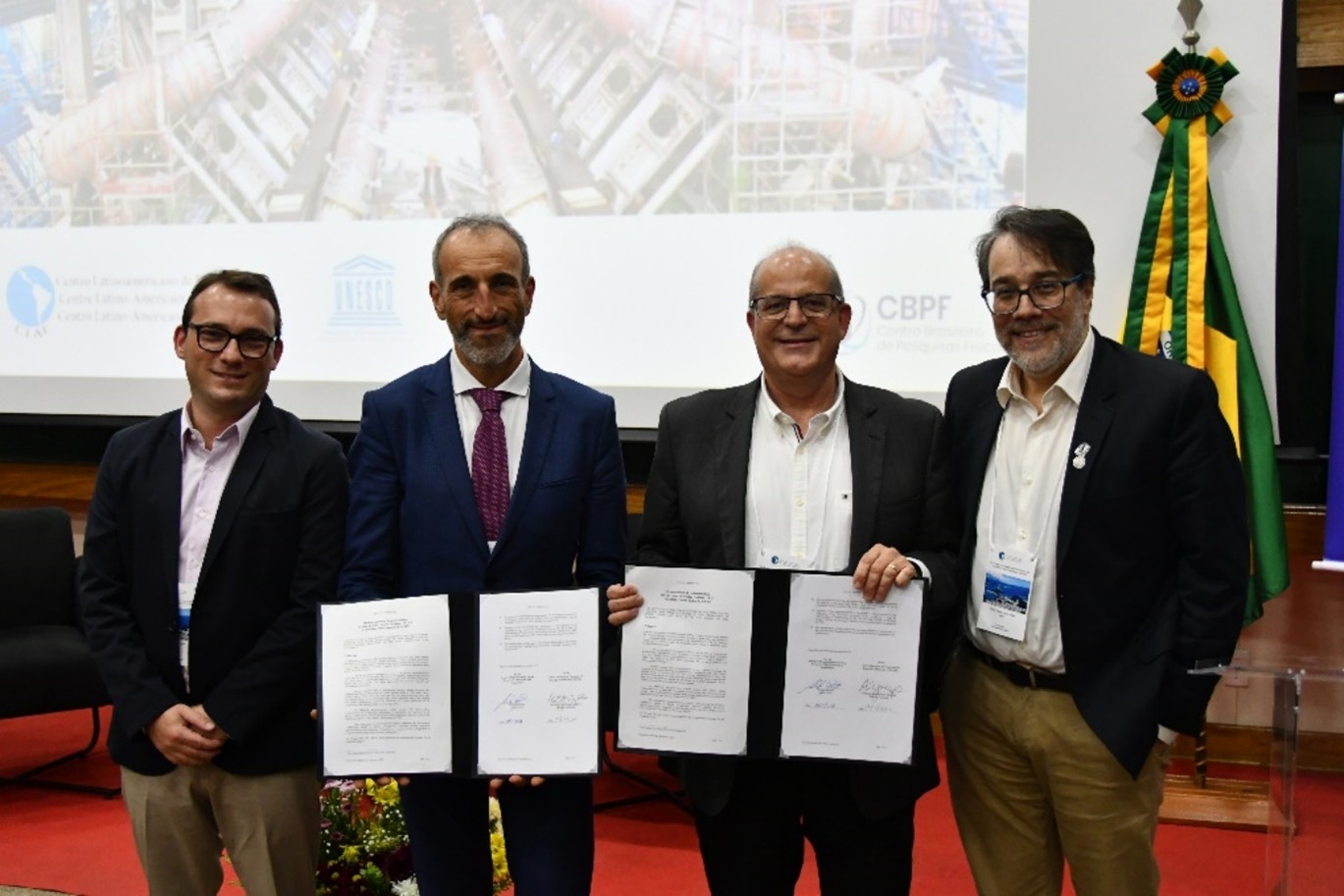
One of the highlights of the symposium — concluding the morning program — was the signing of a memorandum of understanding between the Brazilian National Center for Research in Energy and Materials (CNPEM) and CERN, for participation in the study for the FCC (Future Circular Collider), an accelerator currently being planned by the European laboratory.
The memorandum was signed between Michael Benedikt (Austria), current leader of the FCC study project, and Antônio José Roque, director of CNPEM. “Five years ago, I would have said that this initiative was nothing more than a dream,” emphasized Salvatore Mele, who was present at the ceremony. Roque, in turn, thanked his colleague from CERN for “making this a reality.”
The signing ceremony included the participation, via videoconference, of physicist Michael Benedikt. “We are very pleased with this initiative,” he said.
The CNPEM–CERN collaboration includes active participation of Brazilian industry in the construction of the FCC. The report on the technical and financial feasibility of the accelerator — which could replace the current LHC (Large Hadron Collider) — has just been published by the European laboratory headquartered in Geneva, Switzerland.
Scientific Sessions
In the afternoon, three panels —bringing together four Brazilian researchers, two Chileans, and two Portuguese— addressed the scientific aspects of the participation of Brazil, Chile, and Portugal in CERN experiments, as well as Portugal’s involvement in neutrino research in DUNE (Deep Underground Neutrino Experiment), in the United States, in which Brazil also participates.
Two more lectures followed on broader topics. Cristiane Jahnke (Brazil) presented the results of a survey of Latin American physicists on strategies for the next generation of accelerators. According to the speaker, about 85% of Brazilian physicists surveyed support the construction of the FCC.
Rogério Rosenfeld (Brazil) presented details on LAA-HECAP (Latin American Association for High-Energy, Cosmology and Astroparticle Physics), created in 2021 to promote, plan, and expand research and international collaboration in these areas in the region.
Around 6 p.m., Almeida, CLAF director, closed the symposium by proposing the creation of a ‘Latin American Cooperation Group in High-Energy Physics’ between CLAF and CERN, to promote more effective regional and international integration in this field. “As ambitious as this idea may seem — and indeed it is — I believe it is precisely rooted in the ambition with which CLAF was created.”
The symposium was organized in coordination with the international conference ‘Advances in QCD at the LHC and the EIC,’ also held in Rio de Janeiro (RJ), from November 9 to 15 of this year.
More information:
About the symposium (with PDF presentations): https://claffisica.org.br/page/claf-symposium
About CLAF: https://claffisica.org.br/