


[15/12/2025]
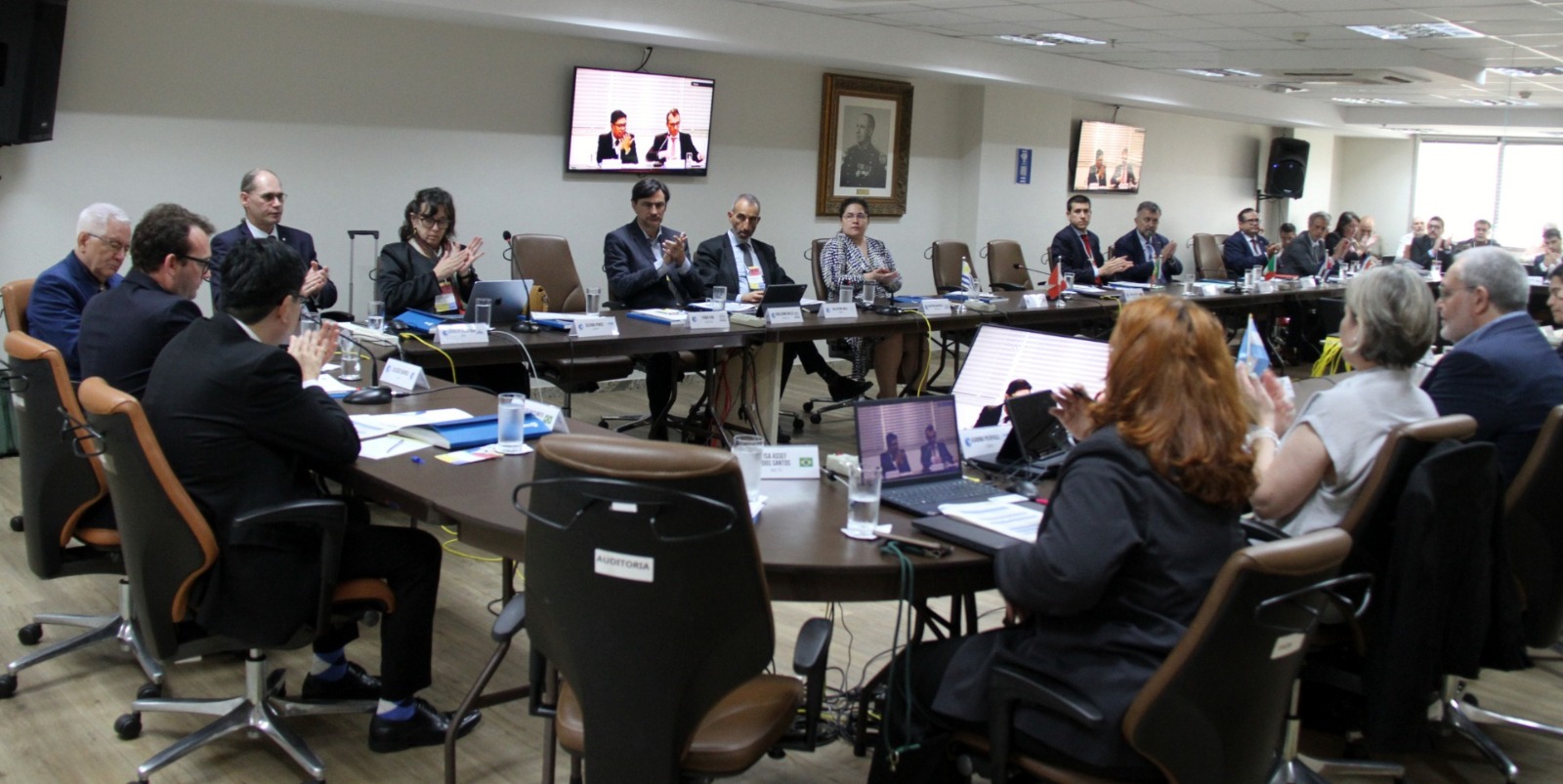
The Latin American Center for Physics (CLAF) and the Ministry of Science, Technology and Innovation (MCTI) held a seminar on perspectives for scientific collaboration in physics in Latin America on December 5th in Brasília.
The essence of the meeting—which brought together ambassadors, government authorities, and researchers from various countries—can be summarized by the following expression: diplomacy for science and science to promote diplomacy.
The 'CLAF-MCTI High-Level Seminar—Perspectives for Scientific Collaboration in Physics in Latin America', with approximately 45 participants from 12 countries, extended throughout the day at the headquarters of the National Council for Scientific and Technological Development (CNPq).
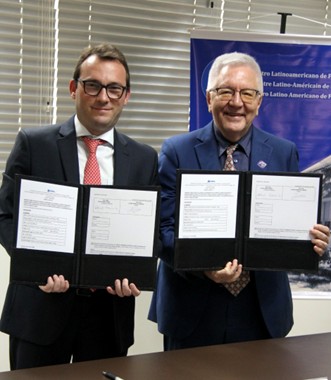
There were four major panels, presentations on specific themes, and the signing of an agreement in which CNPq grants CLAF, starting next year, doctoral and postdoctoral fellowships for students from the region—see, on this portal, https://claffisica.org.br/news-item/claf-and-cnpq-sign-cooperation-agreement-for-graduate-and-postdoc-scholarships-in-physics
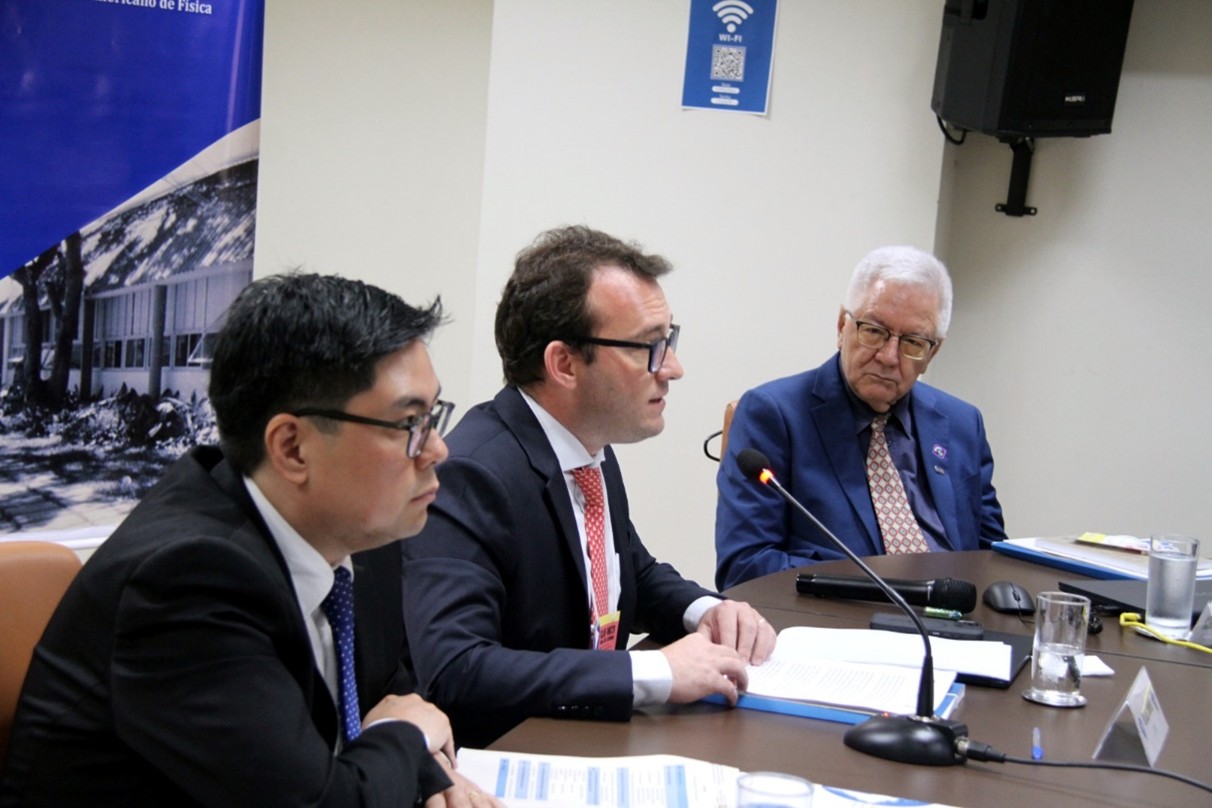
At the opening ceremony, speakers included physicist and science historian Olival Freire Júnior, president of CNPq; experimental physicist Ulisses Barres de Almeida, director of CLAF and researcher at the Brazilian Center for Physics Research (CBPF) in Rio de Janeiro (RJ); and Carlos Matsumoto, head of the special advisory office for international affairs at MCTI.
Diplomacy for Science
With Chilean physicist Luis Huerta Torchio, former director of CLAF, as moderator, the first panel brought together ambassadors from five Latin American countries, who spoke about national perspectives on scientific cooperation in Latin America.
Panel participants included Carlos Eugenio de Alba, ambassador of Mexico in Brasília; Ambassador Eugênio Vargas Garcia, director of the Department of Science, Technology and Intellectual Property at Itamaraty; ambassador Sebastián Depolo, ambassador of Chile in Brasília; Norman Lizano Ortiz, ambassador of Costa Rica in Brasília; and Guillermo Daniel Raimondi, ambassador of Argentina in Brasília.
The emphasis of the presentations was on so-called 'diplomacy for science'—that is, how foreign policy and international relations can promote both science and scientific collaboration in Latin America.
At the end of the presentations, moderator Huerta Torchio said that CLAF should go beyond its role as an institution for scientific collaboration and promotion of physics, acting as "a strategic agency" for the region.
Global South, Unesco and History
Next came interventions on specific themes. Experimental physicist Marcelo Knobel, executive director of The World Academy of Sciences (TWAS) and former rector of the State University of Campinas (Unicamp), focused his speech on the so-called 'Global South', a geopolitical concept that basically designates countries in Latin America, Africa and Asia. Highlighting the significant participation of this region in global scientific production, he emphasized that "the Global South is no longer considered periphery."
Guatemalan physicist Fernando Quevedo, professor at New York University Abu Dhabi (United Arab Emirates) and the University of Cambridge (United Kingdom), presented an overview of high-energy physics in Latin America, highlighting the main experiments in the region and those in which Latin American researchers participate on other continents—such as the European Organization for Nuclear Research (Switzerland) and Fermi National Laboratory (USA). At the end of his speech, he raised questions about whether there should be a joint doctoral program for the region and whether Latin America should participate as "a bloc" in the Future Circular Collider—an accelerator approximately 90 km in length planned by CERN for the coming decades.
Economist Guillermo Anlló, program specialist at the Regional Office of the United Nations Educational, Scientific and Cultural Organization (Unesco) for Latin America and the Caribbean, reinforced the importance of the role of scientific collaboration in a world undergoing drastic geopolitical changes and crises affecting all nations, such as climate change. "We need more science and diplomacy" to face this scenario. "This meeting is an example of that," he said.
Science historian Antonio Augusto Passos Videira, from the State University of Rio de Janeiro (UERJ) and visiting researcher at CBPF, presented a historical analysis of the founding of CLAF, in the context of the Cold War, Big Science, and the political and economic scenario of the region in the early 1960s, in which governments did not see science as an engine for development. "It is a history that has yet to be written," he said, emphasizing that the founding scientists of CLAF "acted as diplomats" to emphasize "the social relevance of physics" for the region.
Cooperation in the Region
Concluding the morning part of the seminar, the second panel was moderated by computer scientist Adriana Cursino-Thomé, general coordinator of multilateral cooperation at MCTI. The guests spoke about opportunities for scientific cooperation in Latin America.
Participants included experimental physicist Rubem Sommer, researcher at CBPF; Argentine physicist Silvina Ponce Dawson, president of the International Union of Pure and Applied Physics (IUPAP); Matsumoto, from MCTI; Ignacio Silva Santa Cruz, head of the Division of Emerging Technologies at the Ministry of Science, Technology, Innovation and Knowledge of Chile; and Fabio Eon, coordinator of natural sciences at Unesco in Brasília.
Sommer presented an overview of CBPF, emphasizing the current predominant role of scientific instrumentation development. He also presented images of what the Mário de Almeida Pavilion will look like after renovation—CBPF's first permanent headquarters and CLAF's historic headquarters in Rio de Janeiro (RJ).
Dawson, at the end of her speech, launched the challenge of establishing an agency for regional science funding. "When funds come from outside, [regional] collaboration weakens," she said. Matsumoto said the government is working to ensure that investments in science in Brazil reach 2% of Gross Domestic Product and that coordination is key to collaboration in the region. "It is not easy, but it is the best alternative."
Santa Cruz highlighted the importance of Chile's entry as an Associate Member State of CERN, formalized last year—and currently awaiting ratification by the Chilean congress. He also highlighted the national program for his country to supply ultra-high purity copper to scientific institutions and industries in other countries.
Eon emphasized Unesco's role in reducing asymmetries through science. He said that the institution's various regional offices—with a large number of specialists—are at the disposal of Latin American researchers for the promotion of science. Finally, he emphasized that the institution has a vast collection (freely accessible) of standardization documents on scientific topics.
Large Structures
The afternoon activities of the seminar began with the third panel, whose theme was the role of large research infrastructures for scientific cooperation. Moderation was by Sommer, from CBPF.
The speakers were physicist Salvatore Mele, senior advisor for international relations at CERN; engineer Karina Pierpauli, from the National Atomic Energy Commission of Argentina (CNEA); José Antônio Roque, director of the Brazilian Center for Research in Energy and Materials (CNPEM); and Slovak biophysicist Norbert Kucerka, director of the Frank Laboratory of Neutron Physics, one of the facilities at the Joint Institute for Nuclear Research (JINR) in Dubna, in the Moscow region.
Mele initially described the technologies generated by CERN—which are transferred to industry. At the end of his speech, he highlighted that since 2020, the number of Latin American researchers at the European laboratory has grown approximately sevenfold. "We are witnessing a Latin American moment at CERN," he said.
Pierpauli gave an overview of Argentina's nuclear structure, emphasizing the various fields and applications of this area, with technology transfer to industry. Among the country's various reactors, she highlighted the RA-10, which, in its current construction phase, will serve for the production of radioisotopes for medical applications—Brazil is developing a similar machine, the Brazilian Multipurpose Reactor.
Roque presented an outline of CNPEM's infrastructure and research and its close collaboration with Brazilian industry. He spoke about Orion, a high biosafety laboratory that will be the world's first connected to a synchrotron radiation line, generated by the Sirius electron accelerator at CNPEM. He highlighted an agreement with CERN for the supply of superconducting equipment for the FCC.
Kucerka outlined the vast structure of equipment and laboratories at JINR, with which Brazil maintains a partnership through a memorandum of understanding signed this year between the institute and MCTI. JINR has international renown for the production of so-called 'superheavies', unstable chemical elements whose proton number is above 100.
CLAF Today
The last of the panels brought together former directors and specialists to discuss CLAF's current role. Speakers included Huerta Torchio; physicist Alberto Baruj, vice president for technological affairs at the National Council for Scientific and Technical Research (Conicet) of Argentina; physicist Carlos Alberto Aragão, director of scientific and technological development at the Funding Authority for Studies and Projects (Finep) of Brazil; and Anlló, from Unesco. The panel was moderated by Dawson, from IUPAP.
Torchio said that the seminar "redefines CLAF," marking a "new era" for the institution, which, he repeated, should act "as an actor of diplomacy for science." Baruj made a similar comment: CLAF "now has a new beginning," emphasizing the importance of the center in a region where, in many countries, "science remains either erratic or symbolic."
Aragão focused his speech on Finep's role in funding academic and industrial projects in areas such as infrastructure, innovation, nuclear physics, artificial intelligence, quantum technologies, bioeconomy, and international cooperation. He said that CLAF should, from now on, "act as an intermediate boson"—a reference to particles that 'carry' the forces of nature—acting through diplomacy for science, which, according to him, has the capacity to influence governments.
Anlló emphasized the challenges for scientific cooperation. "How do we put it into practice?" he asked. He said that the meeting is an opportunity for CLAF to "establish its own diplomacy" and not that of its member countries.
Dawson, at the end of the panel, launched a "provocation" to participants: in an era when biology is considered "the queen of sciences," how to convince governments that physics is important. The responses were, in general, consensual: physics is the science with a vast number of applications (artificial intelligence, quantum technologies, energy transition, climate change, for example), a driving force behind solving multidisciplinary problems, as is the case with biological and biomedical studies conducted using accelerators.
Closing
Closing the seminar, Ulisses Barres de Almeida, director of CLAF, stated that the presence of five ambassadors, as well as authorities and researchers from various parts of the world, "show the relevance of CLAF," which, for him, has a fundamental role as a "point of convergence" for the interests of the Latin American physics community.
Almeida, complementing his colleague from Finep's analogy, said that CLAF perhaps plays more "the role of gluons"—particles that act as 'glue' in the atomic nucleus—than that of bosons. "Either way, CLAF has legitimacy and should be an arena for discussing current opportunities for physics in the region," he said. "Especially because these opportunities change with the times," he added.
The seminar in Brasília was the second major international meeting promoted by CLAF this year. On November 14th, at CBPF, there was the 'CLAF Symposium—Opportunities for Latin-American Cooperation in High-Energy Physics with CERN', which had the participation of approximately 60 researchers from Latin America and Europe—see, on this portal, https://claffisica.org.br/news-item/claf-symposium-discusses-opportunities-for-latin-america-in-high-energy-physics’
More information:
CLAF: https://claffisica.org.br/
MCTI: https://www.gov.br/mcti/pt-br
CNPq: https://www.gov.br/cnpq/pt-br
Finep: http://www.finep.gov.br/
Simpósio do CLAF: https://claffisica.org.br/news-item/simpsio-do-claf-discute-oportunidades-para-a-amrica-latina-em-fsica-de-altas-energias
Acordo de bolsas CLAF-CNPq: https://claffisica.org.br/news-item/claf-e-cnpq-assinam-acordo-de-cooperao-para-bolsas-de-ps-graduao-e-ps-doc-em-fsica