


[25/09/2026]
Two representatives of the Latin American Center for Physics (CLAF), accompanied by a Brazilian diplomat, traveled to a vertiginously high mountain in Bolivia to put forward an idea that is as challenging as it is important: turning a physics laboratory that reaches into the clouds into a World Heritage site.
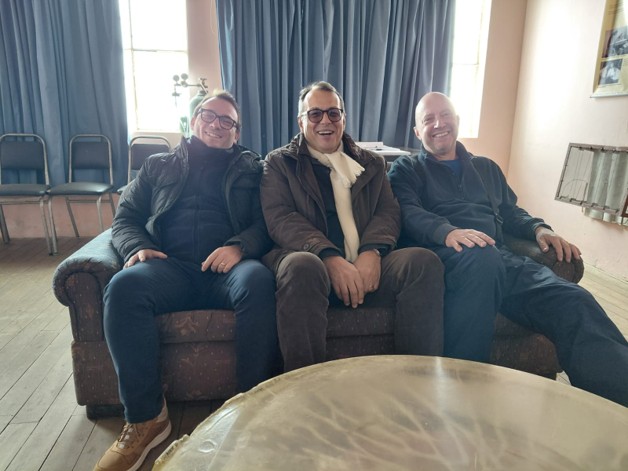
Ulisses Barres de Almeida, director of CLAF; Antonio Augusto Passos Videira, coordinator of CLAF’s ‘Research Unit on the History of Physics in Latin America’; and diplomat André João Rypl, secretary of the Embassy of Brazil in La Paz, visited Nevado Chacaltaya, at about 5,000 meters above sea level, to see the facilities of the Chacaltaya Cosmic Ray Physics Laboratory in the Andes.
The three Brazilians’ trip to the summit is part of a campaign launched this year by Barres to bring to the United Nations Educational, Scientific and Cultural Organization (UNESCO) the proposal to turn the Andean laboratory into a World Heritage site.
“Chacaltaya is one of the most remarkable examples of the worldwide relevance achieved by physics research on our continent from its earliest days, and one of the most important chapters in its history. Since the 1940s, even before the creation of emblematic institutions such as the European Organization for Nuclear Research [CERN], the laboratory has helped build scientific bridges among Latin America, Europe, and Japan, serving as a hub for scientific development in the region,” said Barres, an experimental physicist and researcher at the Brazilian Center for Research in Physics (CBPF), in Rio de Janeiro, Brazil.
Barres continued: “Since then, Chacaltaya has never ceased to serve as a beacon that, as a symbol of heroic pioneering, reminds us of the role that science and physics have played in the history and formation of our continent. Preserving and valuing this history also means preserving an important part of Latin American heritage.”
Before that, however, this initiative must go through important steps: the Bolivian government must declare the laboratory a national cultural heritage site—something already being pursued by authorities in the Department of La Paz, Bolivia. These proceedings also have the support of the Universidad Mayor de San Andrés (UMSA), to which the laboratory belongs.
CLAF representatives took advantage of their stay in Bolivia to visit the Brazilian Embassy in La Paz, where they were received by Ambassador Luís Henrique Sobreira Lopes. On that occasion, they had the opportunity to present the proposal and share information about Chacaltaya’s history and importance to science.
A Brief History
Nevado Chacaltaya has more than enough of a résumé to merit consideration for UNESCO recognition: its extensive contributions to science, especially cosmic-ray physics, tell a story that began to gain international recognition in the second half of the twentieth century.
To understand these contributions to the development of science, it is necessary to go back to 1947, when, in Bristol, United Kingdom, the team of British experimental physicist Cecil Powell (1903-1969) detected the pi meson, a subatomic particle that acts as a ‘glue’ for protons and neutrons. It had been proposed in 1934 by Japanese physicist Hideki Yukawa (1907-1981), who received the 1949 Nobel Prize in Physics for this important theoretical prediction.
The Bristol team’s discovery—which earned Powell the 1950 Nobel Prize in Physics—is considered one of the most important achievements in twentieth-century physics and involved the decisive participation of a young Brazilian physicist, César Lattes (1924–2005), who was then working in the United Kingdom.
In search of more such events, Lattes proposed exposing detectors (special photographic plates) at even higher altitudes—the Bristol experiment had been conducted at Pic du Midi, in the French Pyrenees, at about 2,800 meters. The higher the altitude above sea level, the greater the flux of cosmic rays, which are atomic nuclei that constantly bombard Earth’s atmosphere, causing collisions that produce new particles (including the pi meson, or, in modern terminology, the pion).
On a map in the University of Bristol library, Lattes found Chacaltaya, at about 5,500 meters. Another advantage of the new site was that the mountain was close (about 20 km) to Bolivia’s seat of government, La Paz, making travel there easier.
On his first visit to Nevado Chacaltaya, Lattes found a modest weather station there. The plates exposed on the mountain yielded hundreds of new events involving the pi meson—about 30 of them ‘complete,’ meaning that the particle disintegrates (technically, decays) into another particle, the muon, a heavy ‘cousin’ of the electron.
Lattes saw great potential in Chacaltaya: after all, the energies of cosmic rays at those altitudes can be 10,000 to 100,000 times greater than the levels reached even today in collisions occurring in accelerators such as the LHC (short for Large Hadron Collider) at CERN, headquartered in Switzerland.
After the results obtained from exposing the plates at Nevado Chacaltaya were published in the prestigious British journal ‘Nature’ in October 1947, the mountain became a focus of attention for the international physics community. As a result, several countries expressed interest in the site; a typical example was the installation of a U.S. experiment there.
Lattes realized that he might ‘lose’ the site to other countries. This led him to sign, on an urgent basis, an international collaboration agreement with UMSA in La Paz in the early 1950s.
Thus, the Chacaltaya Cosmic Ray Physics Laboratory was born—a fact few people know: it was a Division of Physics affiliated with CBPF, an institution founded on January 15, 1949, in Rio de Janeiro, Brazil.
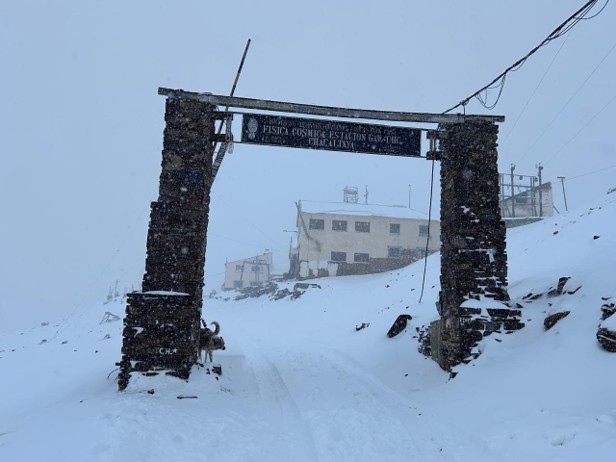
Since then, numerous experiments have been conducted on the mountain. Among them, several focused on cosmic radiation deserve mention: the so-called UNESCO Mission, an international collaboration that, in the early 1950s, brought a cloud chamber (detector) to Chacaltaya, donated to Brazil by the University of Chicago (U.S.); the CBJ (Brazil–Japan Collaboration), which began in 1962 and continued for about 30 years; BASJE (Bolivian Air Shower Joint Experiment), also from that period; and, currently, Alpaca (Andean Large Area Particle Detector for Cosmic-Ray Physics and Astronomy), also in collaboration with Japan.
This long list of contributions to physics led CLAF to launch a project on the history of the Chacaltaya Cosmic Ray Physics Laboratory, aimed at recovering and organizing the story of one of the oldest and most important laboratories in Latin America.
According to Videira, “this laboratory can be understood as one of the first attempts, in the natural sciences, to establish a network of collaborators in the field of cosmic rays.”
Led by CLAF’s ‘Research Unit on the History of Physics in Latin America,’ “this initiative will bring together historians of science, physicists, diplomats, cultural representatives, and university and government authorities to persuade UNESCO to declare Chacaltaya a historical and scientific heritage site of humanity,” Videira added. Videira is a historian of science affiliated with the State University of Rio de Janeiro and CBPF.
UMSA: 60 Years of the Physics Program
During their recent visit to Bolivia, Barres and Videira took part in the celebration of the 60th anniversary of the creation of the undergraduate physics program at UMSA’s Faculty of Pure and Natural Sciences. The event was attended by the university’s rector, María Eugenia García Moreno; vice rector, Tito Valerio Estévez Martini; dean of the Faculty of Pure and Natural Sciences, Aldo Ramírez; and other academic authorities and representatives of students and faculty.
Beyond cosmic-ray research, the celebration highlighted the contribution of experiments at Chacaltaya to both theoretical and applied research in atmospheric physics and geophysics, among other fields.
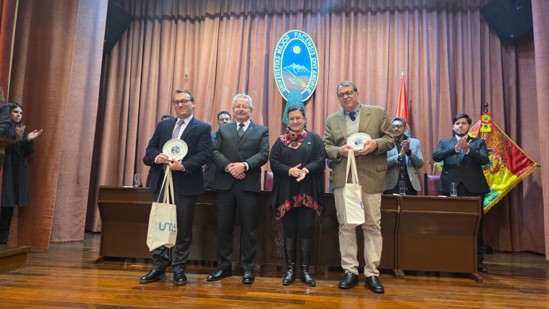
In his speech, UMSA’s vice rector emphasized that the physics program at the institution “has demonstrated that science cannot be detached from the country’s reality,” highlighting “the importance of continuing to strengthen research and scientific education so that the knowledge generated by the university can help us understand our natural phenomena, address national challenges, and build new possibilities for Bolivia.”
In his speech, Barres highlighted the long-standing collaboration between Brazil and Bolivia in physics. He took the opportunity to announce that, this year, CLAF is launching the creation of a network of Latin American Physics Chairs at strategic institutions across the continent, to serve as hubs for cooperation and integration in Latin America. “I would like to announce today that CLAF wishes UMSA—and, in particular, its physics program—to be one of the institutions to host such a chair, maintaining a special link with the Chacaltaya Cosmic Ray Physics Laboratory,” Barres said.
CLAF’s director concluded his speech with these words: “Therefore, in collaboration with our colleagues at UMSA and with Bolivia’s delegates to CLAF, I invite you to consider this day of historic celebrations also as the first day of a new network of relations between CLAF and UMSA, to build a renewed era of Latin American physics.”
At the event, Barres and Videira received commemorative gifts from UMSA.
More information:
Full text of the speech delivered by the Director of CLAF at the celebration of the 60th anniversary of the UMSA Physics Program: Celebración de los 60 años de la Carrera de Física
UMSA (Vice Rectorate): https://vicerrectorado.umsa.bo/es/cmem/-/asset_publisher/WrjN8OI4d8qk/content/60-anos-de-la-carrera-de-fisica-una-historia-de-ciencia-investigacion-y-servicio-a-bolivia
CLAF: https://claffisica.org.br/
UMSA: https://www.umsa.bo/
Physics – Faculty of Pure and Natural Sciences: https://www.fiumsa.edu.bo/
SDDEPT: https://www.facebook.com/photo?fbid=122124531981358979&set=pcb.122124532305358979