


[10/10/2026]
The campaign to have the Chacaltaya Cosmic Physics Laboratory named a cultural heritage of humanity by the United Nations Educational, Scientific and Cultural Organization (UNESCO) has gained momentum in Bolivia.
The idea, launched this year by experimental physicist Ulisses Barres de Almeida, director of the Latin American Center for Physics (CLAF), in Rio de Janeiro, Brazil, was enthusiastically welcomed by the Universidad Mayor de San Andrés (UMSA), the institution that owns the laboratory, which mobilized government officials, scientists, and students for the campaign.
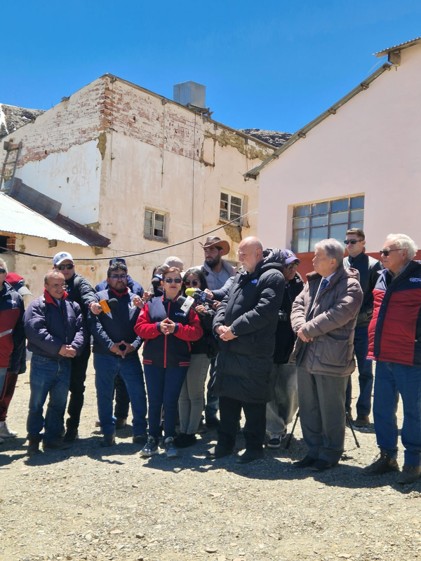
On September 26, a delegation led by UMSA visited the laboratory, which is located about 5,200 meters above sea level in the Andes mountain range.
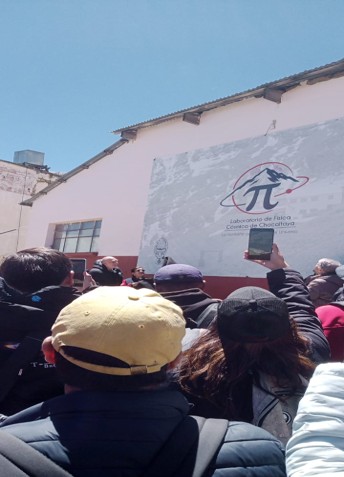
At the ceremony, the campaign logo was unveiled. On that occasion, UMSA rector María Eugenia García Moreno, a chemist, spoke to an audience of approximately 100 people. She thanked the countries and scientists that have believed in Bolivian science and researchers. “This is a very special day, not only for the Universidad Mayor de San Andrés, not only for Bolivia, but also for science around the world. As of today, we are launching the campaign for the Chacaltaya Laboratory as a UNESCO heritage site,” García said.
Among those present were Brazil’s ambassador to Bolivia, Luís Henrique Sobreira Lopes, and the chargé d’affaires of the Embassy of Japan in La Paz, Shigetomo Maruhashi —Japan and Brazil have a long tradition of collaboration with Bolivia on experiments at Chacaltaya.
The UNESCO campaign—which now also has a web page—must first clear an earlier hurdle: the laboratory must be declared a national cultural heritage site, an initiative that already has public support, for example, from the Government of the Department of La Paz.
The “pi” in the logo
The campaign logo prominently features the Greek letter pi (π), surrounded by elements reminiscent of an atom with its nucleus, with Mount Chacaltaya in the background. It also bears the words: “Chacaltaya Cosmic Physics Laboratory – The mountain that observes the universe.”
The Greek letter refers to one of the most important discoveries of twentieth-century physics, to which Chacaltaya made an important contribution: the pi meson (or, in modern terminology, the pion), a subatomic particle that holds the atomic nucleus together by mediating a force that binds protons and neutrons.
The pion was detected in 1947 by a team of researchers at the University of Bristol (United Kingdom), with decisive participation by the then-young Brazilian physicist César Lattes (1924–2005).
In the middle of that year, Lattes traveled from England to Bolivia to expose more detectors (special photographic plates) on Mount Chacaltaya. The Brazilian brought back about 30 new pion tracks on the photographic plates—up to that point, the British group had detected only two of these mesons, through exposures at the Pic du Midi, in the French Pyrenees.
The pions “captured” at Chacaltaya made it possible to calculate the mass of this particle precisely—something that was not possible with only two events. For this work, the leader of the Bristol group, British physicist Cecil Powell (1903–1969), won the 1950 Nobel Prize.
Pages and news
The web page created especially for the pro-Chacaltaya campaign—still under construction, its authors caution—is already available online (see “More information”). Also available in Portuguese, it includes, for example, a detailed chronology of the laboratory’s history; a text about the UNESCO nomination; and details of the experiments currently under way at the site—two of them are Alpaca (a surface and underground network of detectors for the study of cosmic rays) and GAW/CHC (an atmospheric monitoring station of the World Meteorological Organization)—the latter “one of the very few global high-altitude stations on the planet.”
On the page, one can also read a statement by the Cosmic Ray Commission of the International Union of Pure and Applied Physics (IUPAP), dated February 28, 1964, attesting to the historical importance of both Chacaltaya (Bolivia) and Kolar (India): “[...] the IUPAP Commission considers that these two experimental sites are essential for research in this scientific field.”
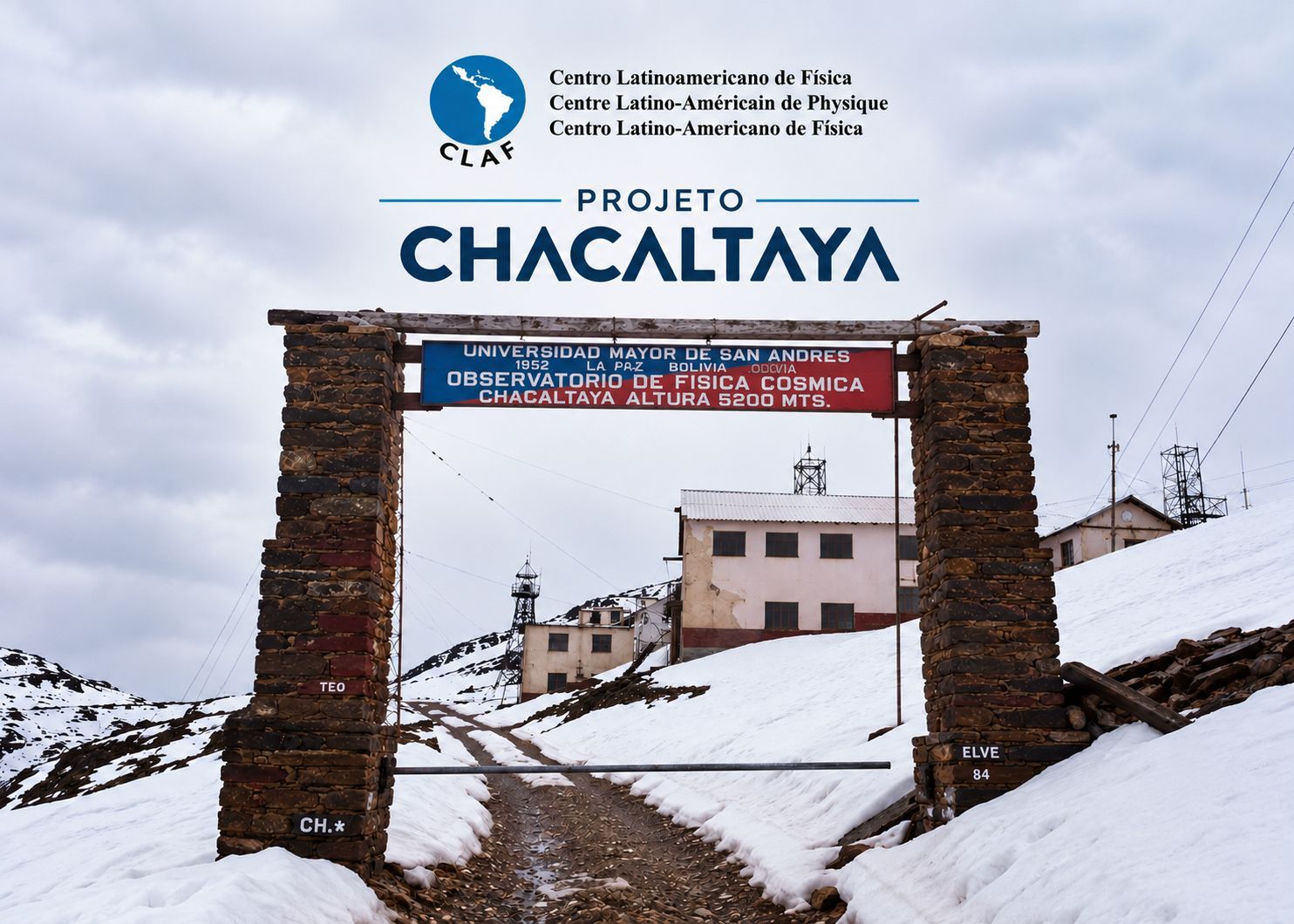
CLAF has also prepared a logo—with photographic elements—for its “Chacaltaya Project,” which is the responsibility of its “Research Unit on the History of Physics in Latin America.” One of the initiative’s goals—which will bring together historians of science, physicists, diplomats, cultural agents, and university and government officials—is to gather and systematize historical material to support the campaign with UNESCO.
In addition to the logo and the web page, UMSA also prepared, for the occasion, an exhibition at the laboratory on the history of the science done on that mountain over the past eight decades.
The September 26 event received extensive coverage in the Bolivian media (see “More information”).
More information:
Página da campanha na USMA: https://chacaltaya-lfc.umsa.bo/portada_PT.html
Embaixada do Japão: https://www.bo.emb-japan.go.jp/itpr_ja/11_000001_02906.html
Levantate Bolivia: https://www.facebook.com/watch/?v=1607242150840904
RTP Bolivia: https://www.facebook.com/reel/4384321528496201
Proyeto Tuya: https://www.facebook.com/reel/1080405498242638
SM: https://www.facebook.com/reel/2162454157710083
CLAF: https://claffisica.org.br/
UMSA: https://www.umsa.bo/
Faculdade de Ciências Puras e Naturais (UMSA): https://www.fiumsa.edu.bo/
CERN Courier: https://cerncourier.com/a/boost-for-andean-cosmic-ray-laboratory/